CA3 All twelve use casesContact
Brain implant · SPINT decoder · FALCON H1 public recordings

A brain-implant decoder learned seven new days. And kept the days it already decoded.

SPINT, a published decoder for intracortical brain-computer interfaces, learned seven new days of a participant's public recordings, one night at a time, with CA3 deciding what it learned and whether each night's update stayed. The approved decoder never changes.
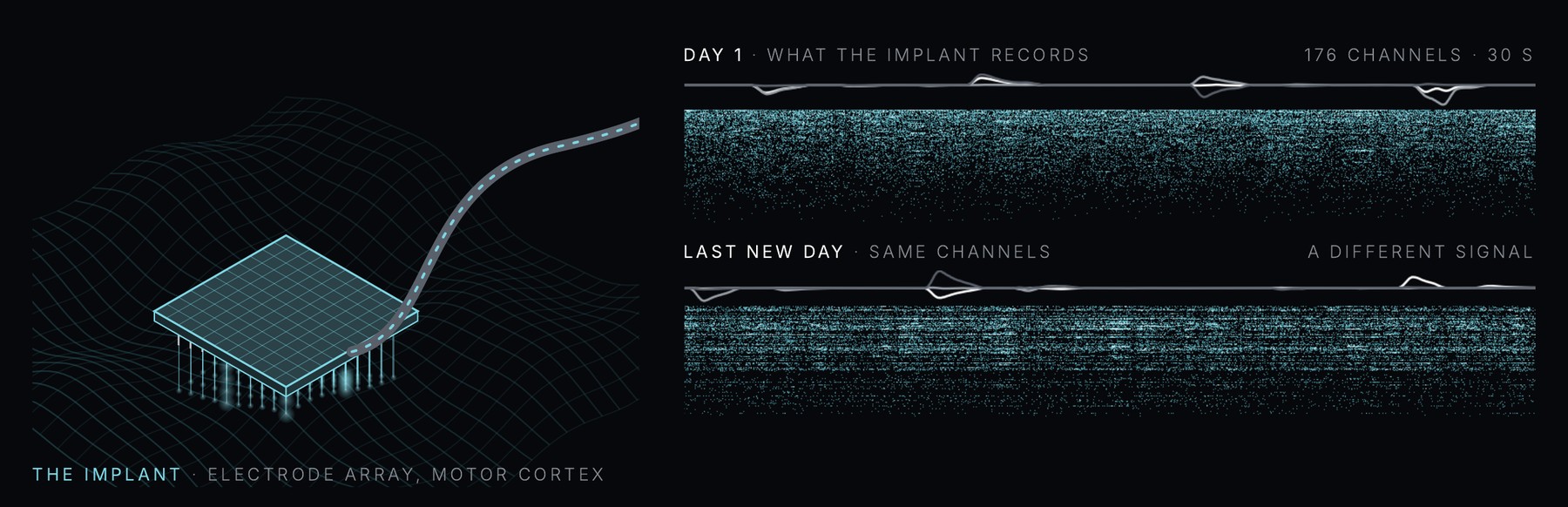
An illustration of the implant, and 30 seconds of what it records on the first day and on the last new day, from the same 176 channels
New days, R²0.283daily recalibration 0.252; ahead on 5 of 7 days
Earlier days, R²0.939approved decoder 0.947; ordinary fine-tuning 0.712
Nightly updates rolled back8 of 14under 0.01 lost on the earlier days, any night
Approved decoderIdenticalbefore, during and after the run
Learns

Each new day, one night at a time.

What an implant records drifts from day to day. Each night the decoder learned from that day's first session; the second session was the test. With CA3 it decoded the new days better than SPINT's own daily recalibration on five of seven.
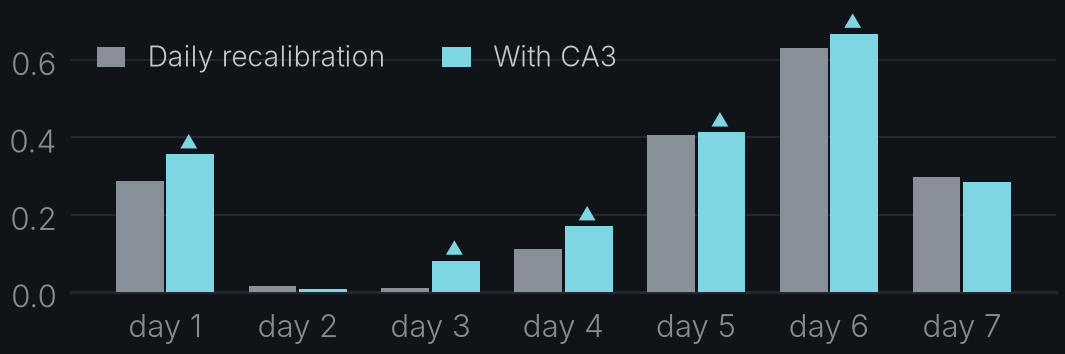
Decoding each new day's held-out session, daily recalibration against CA3, days 1 to 7
0.283mean R² on the new days, with CA3
0.252SPINT's daily recalibration
5 of 7days ahead of the recalibration
Keeps

The earlier days stay.

Retraining on the new days erases the old ones: ordinary fine-tuning on the same seven days dropped the 13 earlier sessions from 0.947 to 0.712. With CA3 they stayed at 0.939.
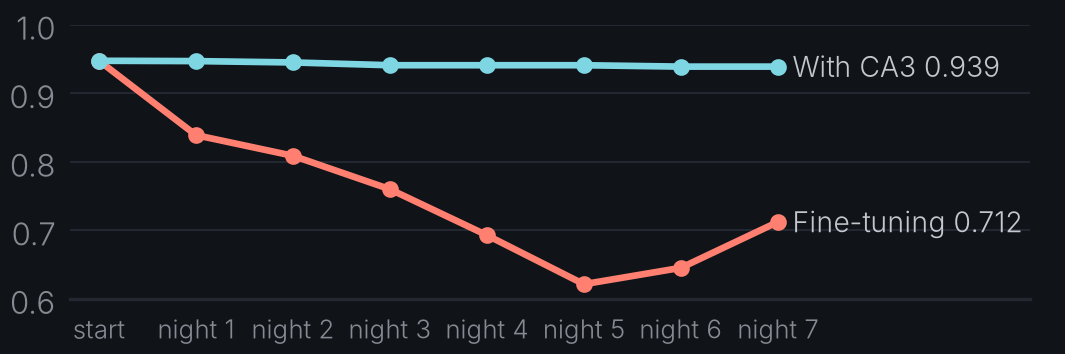
Decoding the 13 earlier sessions night by night: CA3 stays at 0.939, fine-tuning falls to 0.712
0.939earlier days with CA3; the approved decoder 0.947
0.712ordinary fine-tuning
Undoes

It rolls back the nights that would harm.

Every night's update was checked against what the decoder must not lose, then kept or rolled back. Eight of the fourteen were rolled back, and on no night did the earlier days lose 0.01 or more.
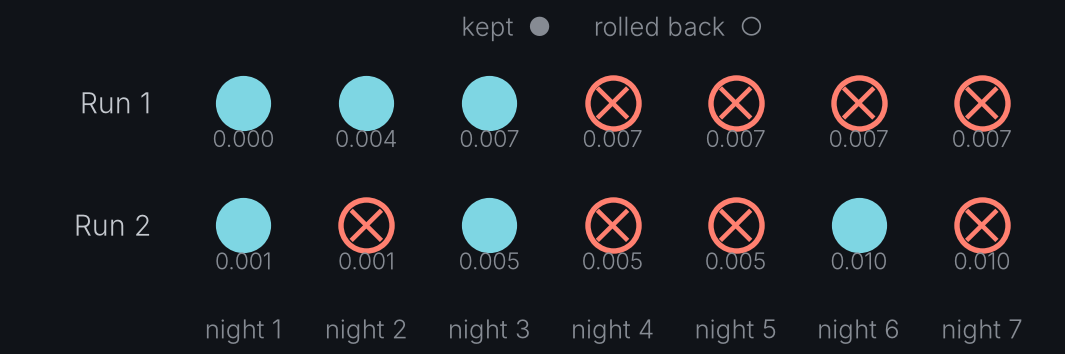
The 14 nightly updates, kept or rolled back, with the R² lost on the earlier days after each
8 of 14nightly updates rolled back by CA3
< 0.01lost on the earlier days, any night
Keeps the original

It never touches the approved decoder.

The fingerprint of the approved decoder, checked through the whole run, never changed. Going back to it is one step.

CheckedFingerprint of the approved decoderSame
Start6bebdbfb7620f731✓
After run 16bebdbfb7620f731✓
After run 26bebdbfb7620f731✓
End6bebdbfb7620f731✓
Why it matters

A decoder that changes every day is a medical device that changes every day.

Regulators expect such changes to be planned in advance and verified against acceptance criteria set beforehand (in the US, a predetermined change control plan). With CA3, each day's learning is one of those changes: checked against criteria fixed in advance, kept or rolled back, and on record.

How the test was run

The test, step by step.

Seven new days, one night each, and the field's usual answers for comparison.

BeforeThe approved decoderSPINT, public code, trained on 13 sessions over 6 days.
Nights 1 to 7One new day per nightLearned from the day's first session; its second session is the test.
Each nightThe update is checkedAgainst what the decoder must not lose.Kept, or rolled back if it would harm the earlier days
Compared withThe field's usual answersSPINT's own daily recalibration, and ordinary fine-tuning on the same days.

Measured: decoding (R²) on each new day's second session, and on the 13 earlier sessions' held-out splits after the seven days. Pass criteria registered before the run: ahead of the recalibration by 0.02 or more on average and on at least 4 of 7 days, and no more than 0.01 lost on the earlier days. All three met.

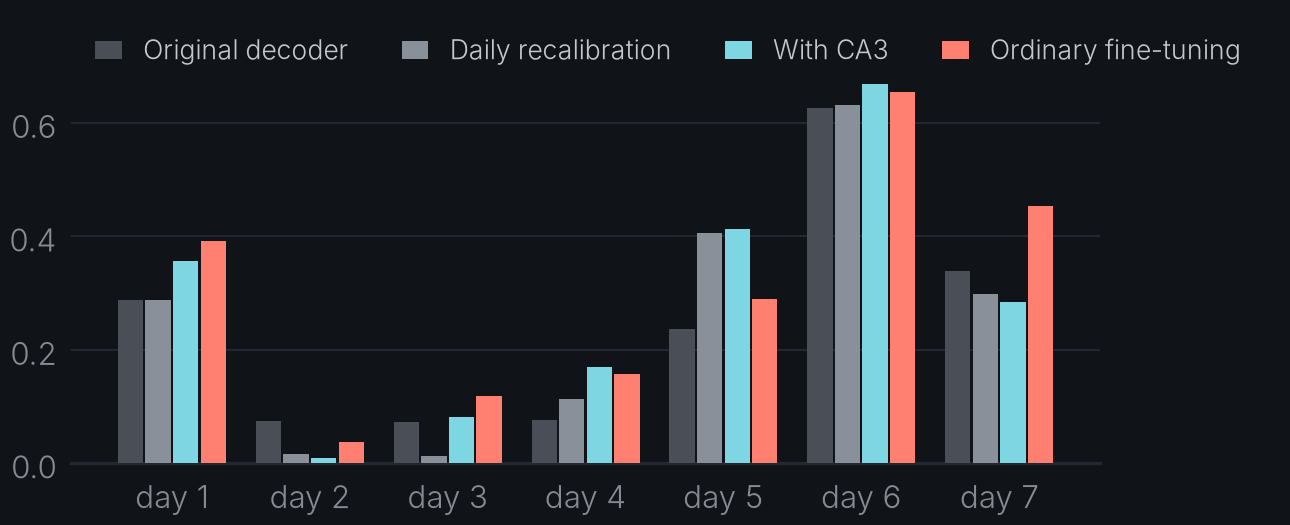
DecoderNew days, mean R²Days ahead of recalibrationEarlier days, R²Nightly updates rolled back
Original decoder0.2450.947
Daily recalibration (SPINT)0.2520.947
Ordinary fine-tuning0.3006 of 70.712none (no control)
With CA30.2835 of 70.9398 of 14
Decoding each new day: the original decoder, daily recalibration, CA3 and ordinary fine-tuning
CA3 learned the new days better than the daily recalibration and kept the earlier days almost where they were.
Fine-tuning learned a little more, and lost a quarter of the earlier days.
The approved decoder was identical at the start and at the end.

Test it on your model.

A pilot on your own decoder and recordings: you choose what it must never lose and what it should learn, and you measure the result on your own benchmark.

ContactAll twelve use cases

Model and data

  • Data: FALCON H1, DANDI 000954 (CC-BY-4.0), intracortical recordings of a human participant.
  • Decoder: SPINT, public code, trained on 13 sessions over 6 days.
  • On top of the page: the first base day and the last new day, the same 176 channels in the same order, 30 seconds each, with the participant's movement on top; the implant is an illustration.

Sources

  • Karpowicz BM, Ye J, Fan C, et al. Few-shot Algorithms for Consistent Neural Decoding (FALCON) Benchmark. NeurIPS 2024 Datasets and Benchmarks.
  • Le T, Fang H, Li J, Nguyen T, Mi L, Orsborn A, Sumbul U, Shlizerman E. SPINT: Spatial Permutation-Invariant Neural Transformer for Consistent Intracortical Motor Decoding. NeurIPS 2025.

Limits

  • One registered run (one seed), one decoder, one participant's public data; earlier forms of the design were run twice before and are on record.
  • Two CA3 runs, each protecting half of the earlier days and read on the other half.
  • FALCON's public sessions, not its official leaderboard.
  • About 4 hours on one GPU, decoder training included.

Results from recorded, pre-registered tests. The mechanism is not shown. Model and dataset names are for identification only. Not produced or endorsed by the FALCON or SPINT authors. CA3 is developed by Alberto Acedo, PhD, at Biome Makers Inc.